As a book reviewer, I received a copy of this book for free from the publisher or author to facilitate this review. I received no other compensation, and all opinions are always 100% my own.
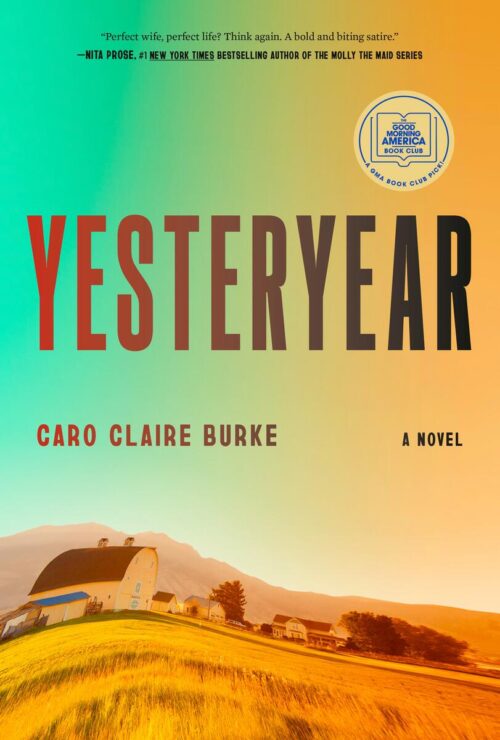
Natalie Heller Mills has a picture-perfect life–literally. As a tradwife influencer with hundreds of thousands of followers, her every day is shown in warm, glowing colors. She makes sourdough bread on camera, takes her photogenic little girls with her to feed chickens. Everything is artfully arranged, from the spill of flour on the counter to the modern appliances hidden behind closet doors. People are hidden too; her 2 nannies, her production assistant who does the filming, the farm workers who do the real work to keep the organic farm producing fresh vegetables, and the pesticides they are secretly using as well.
Natalie awakes one day shivering under a thin quilt instead of an expensive duvet. It seems to be about 1855, and her life has totally changed. No neighbors, no grocery stores, and the only heat and cooking options are the fireplace. Natalie begrudgingly accepts Old Caleb (he looks a lot like her husband but is much older) and these “new” children who aren’t like her former children but somehow still seem to be hers, but she can’t figure out what’s going on. Is this a crazy reality show, and if she gets far enough away she’ll be back in civilization? Or is this a test from a God with whom she seems to have a very strange relationship? (Her “faith” never quite felt right, to be honest)
The novel goes back and forth, from Natalie’s present to her past. As a young woman, Natalie deeply internalized the idea of a woman’s role (wife/mother) as taught to her by her generic ultra-conservative Christian church. (I spent too much time trying to figure out her church tho. It really felt a little sloppy. For example, although it’s ultra-conservative, her mother would get drunk at a church party every Christmas. Really?) Although she gets into Harvard somehow, she is deeply offended by what she views as her roommate’s promiscuity, and for the rest of her adult life lets her freshman roomie live rent free in her head, performing her life as an argument against the idea that women have careers or make other choices for themselves. In fact, Natalie is always performing. She never relaxes. Her face is always stretched into a smile, and her mind is always furiously whirring with plans. She is a very tense woman.
Told from a first person perspective, we see how hard Natalie works to have the life she thinks she ought to have. Yesteryear is a wild ride, but it’ll make you think about the price society demands of women, and the lengths that some are willing to go to meet those demands. However, overall I found the book disappointing. Natalie is never quite believable as a character, and you sense that her creator doesn’t really like her. This could have been an excellent book, and Burke shows promise as a writer, but ultimately the characters were stick-thin and the plot had too many holes.
Leave a Reply